We Attended East Africa's Biggest AI Event: What GITEX Kenya 2026 Taught Us About AI for Schools and Small Businesses
In May 2026, Nairobi hosted something that had never happened in East Africa before: **AI Everything Kenya x GITEX Kenya 2026** — the first African expansion of GITEX, the world's largest technology s
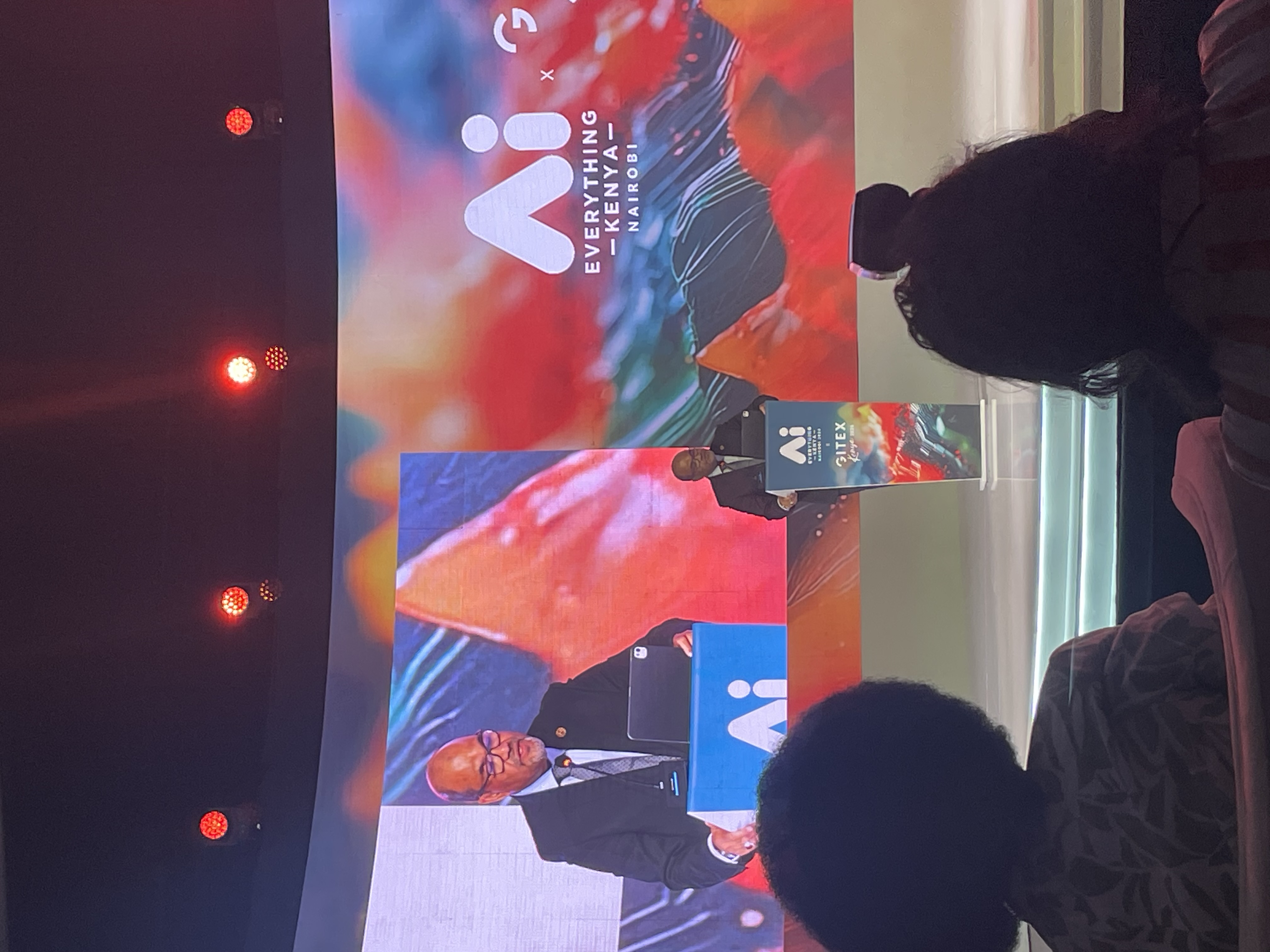
In May 2026, Nairobi hosted something that had never happened in East Africa before: AI Everything Kenya x GITEX Kenya 2026 — the first African expansion of GITEX, the world's largest technology show brand. Over three days, more than 15,000 delegates from 75 countries filled the Sarit Expo Centre and the Kenyatta International Convention Centre (KICC) to see, argue about, and invest in one thing: artificial intelligence.
We were there. Hatz Visuals attended all three days — not as exhibitors, but as a Nairobi creative agency that builds websites and marketing systems for the exact kind of organisations this technology is about to change: schools, small businesses, and growing institutions.
This article is what we brought back. Not hype. Not buzzwords. A practical, plain-language guide to what AI actually is, what we saw at the event, which industries are already using it in Kenya, and — most importantly — what a school director or small business owner in Kenya can do with it starting this month.

The main stage at AI Everything Kenya x GITEX Kenya 2026, KICC Nairobi — East Africa's largest AI gathering to date.
First, the basics: what is AI, in plain language?
Before we go anywhere, let's define the thing properly — because most articles never do.
Artificial Intelligence (AI) is software that can perform tasks that normally require human thinking — understanding language, recognising images, spotting patterns in data, and making predictions. It is not a robot. It is not magic. It is a very capable pattern-recognition system trained on enormous amounts of information.
A few terms you kept hearing at GITEX, decoded:
Generative AI is AI that creates things — text, images, designs, even video. When you type a question into ChatGPT or Claude and get a written answer, that's generative AI. When Canva suggests a complete poster design from a single sentence, that's generative AI too.
A chatbot (or AI assistant) is a program that holds a conversation. The modern versions are trained on your business's real information — your price list, your admission requirements, your opening hours — so they answer customers accurately, instantly, at 2 a.m., without you touching your phone.
Machine learning is how AI gets good at something: you show it thousands of examples and it learns the pattern. A machine learning system that has seen thousands of M-Pesa transactions can learn to flag the suspicious ones automatically.
Automation is connecting these tools together so work happens without you. Payment comes in → receipt is generated → customer gets a WhatsApp confirmation → the sale is recorded in your books. No human touched any of it.
If you understand those four terms, you understood 80% of what was on the floor at KICC.
The event itself: why GITEX coming to Nairobi matters
GITEX started in Dubai in 1976 and grew into the biggest technology show on the planet. When its organisers — KAOUN International, working with Kenya's Office of the Special Envoy on Technology — chose Nairobi for their first East African edition, it was a statement: Kenya is now on the global AI map.
The numbers from the three days back that up:
The event drew over 15,000 delegates from 75 countries, with around 140 global speakers and investors managing more than $50 billion in combined assets. More than 280 enterprises and startups exhibited at KICC — and nearly 60% of them were showing at a Kenyan B2B tech expo for the first time. Global giants like Cisco, HP, Mastercard, ASUS, Fortinet, Kaspersky and Odoo shared floor space with Kenyan startups demonstrating AI-powered point-of-sale systems, WhatsApp sales agents, and smart agriculture tools.
Kenya's Special Envoy on Technology, Ambassador Philip Thigo — the man widely credited with bringing the event home after years of diplomatic groundwork — put the stakes plainly: "AI is Africa's imperative and Kenya its gateway."
And the government came with receipts, not just speeches. ICT Principal Secretary Eng. John Tanui outlined what Kenya has already built: 8 undersea internet cables, a National AI Strategy 2025–2030, over 22,000 government services digitised and serving more than 14 million Kenyans, and a proposed Artificial Intelligence Bill to govern how it's all used. Analysts project AI will contribute US$2.4 billion to Kenya's GDP by 2030 and generate over 300,000 new jobs by 2028.
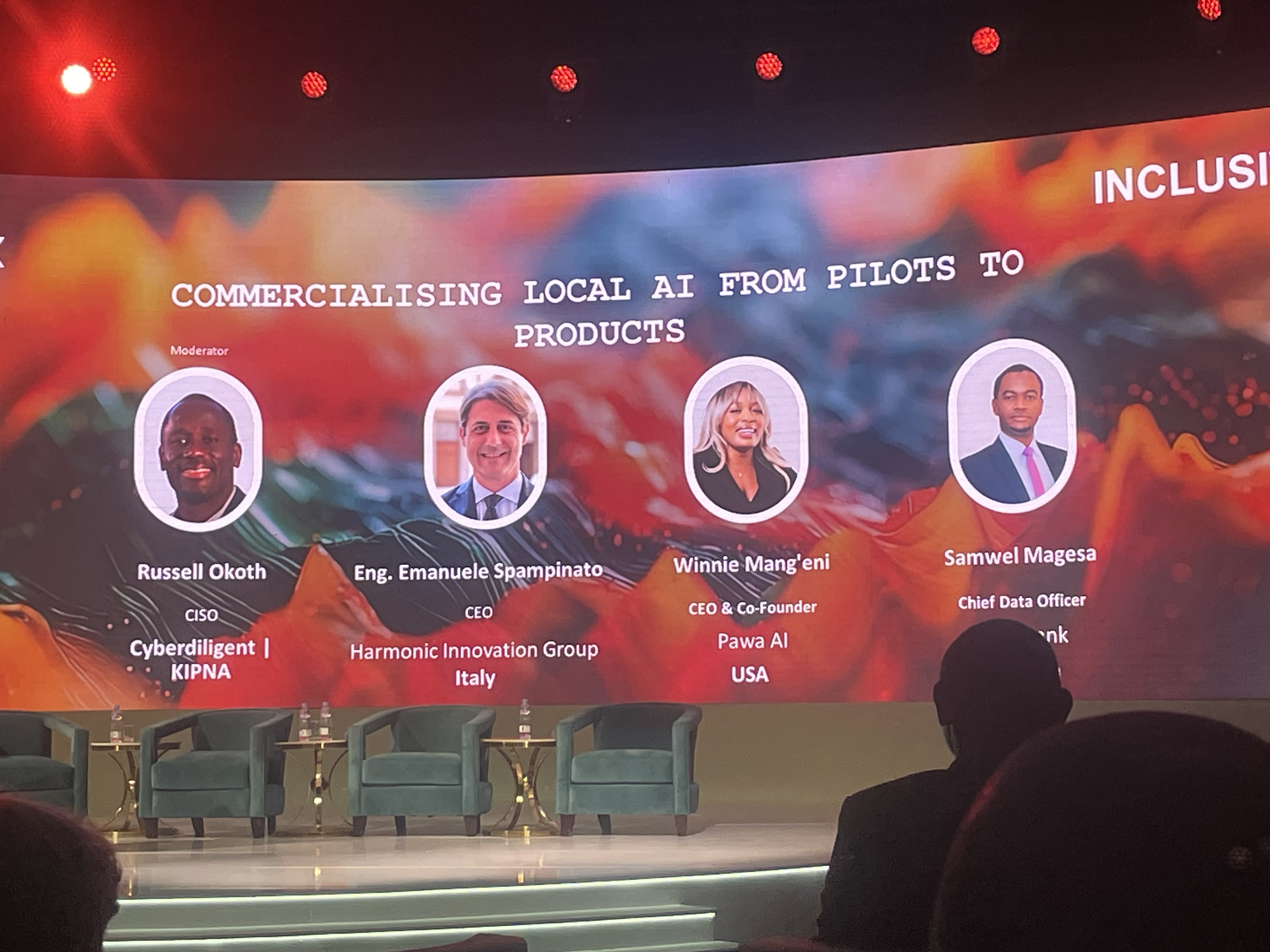
Panel session on commercialising local AI — moving Kenyan innovation from pilot projects to real products.
That last panel title stuck with us: from pilots to products. The message across the entire event was that the experimenting phase is over. AI in Kenya is now about deployment — real tools, in real businesses, this year.
Which industries are using AI right now?
The expo floor was organised around the sectors where AI is already producing results in Africa. Here is what we saw, industry by industry — with concrete examples so you can picture it.
1. Finance and payments (fintech)
Mastercard — which has used AI for nearly two decades — was at the event exploring how algorithms can deepen financial inclusion across the region. In practice, AI in Kenyan finance looks like: fraud detection that flags a suspicious M-Pesa transaction in milliseconds, credit-scoring systems that assess a borrower with no formal bank history by analysing mobile money behaviour, and chatbots that resolve customer queries instantly instead of putting people on hold.
2. Agriculture (agritech)
Kenya's biggest employer got serious attention. AI-powered tools now analyse satellite and drone imagery to monitor crop health, predict yields, and detect disease before a farmer can see it with the naked eye. Precision farming systems tell farmers exactly where to apply fertiliser instead of spreading it evenly and wastefully. For a country where agriculture employs the majority of the workforce, this is not a niche — it's national infrastructure.
3. Healthcare (healthtech)
AI diagnostic tools can screen medical images for signs of disease, extending the reach of scarce specialists. Appointment systems predict no-shows. Chatbots answer basic health questions in Swahili, triaging what needs a real doctor and what doesn't.
4. Education (edutech)
Edutech had its own showcase track — and this is the industry closest to our heart at Hatz Visuals, because we work with schools every day. More on this in the next section, because it deserves it.
5. Cybersecurity
GISEC Kenya, Africa's top cybersecurity platform, ran alongside the main expo. As more Kenyan businesses move online, AI now works both sides: attackers use it to craft more convincing scams, and defenders use it to detect intrusions in real time. The takeaway for a small business: the era of "we're too small to be hacked" is over.
6. Infrastructure: cloud and data centres
One of the biggest announcements at the event: iXAfrica Data Centre confirmed progress on hyper-scale cloud capability in partnership with Oracle. In plain language: the massive computers that power AI are being built here, in Kenya, instead of Kenya renting them from Europe. That means faster, cheaper, sovereign AI services for local businesses in the coming years.
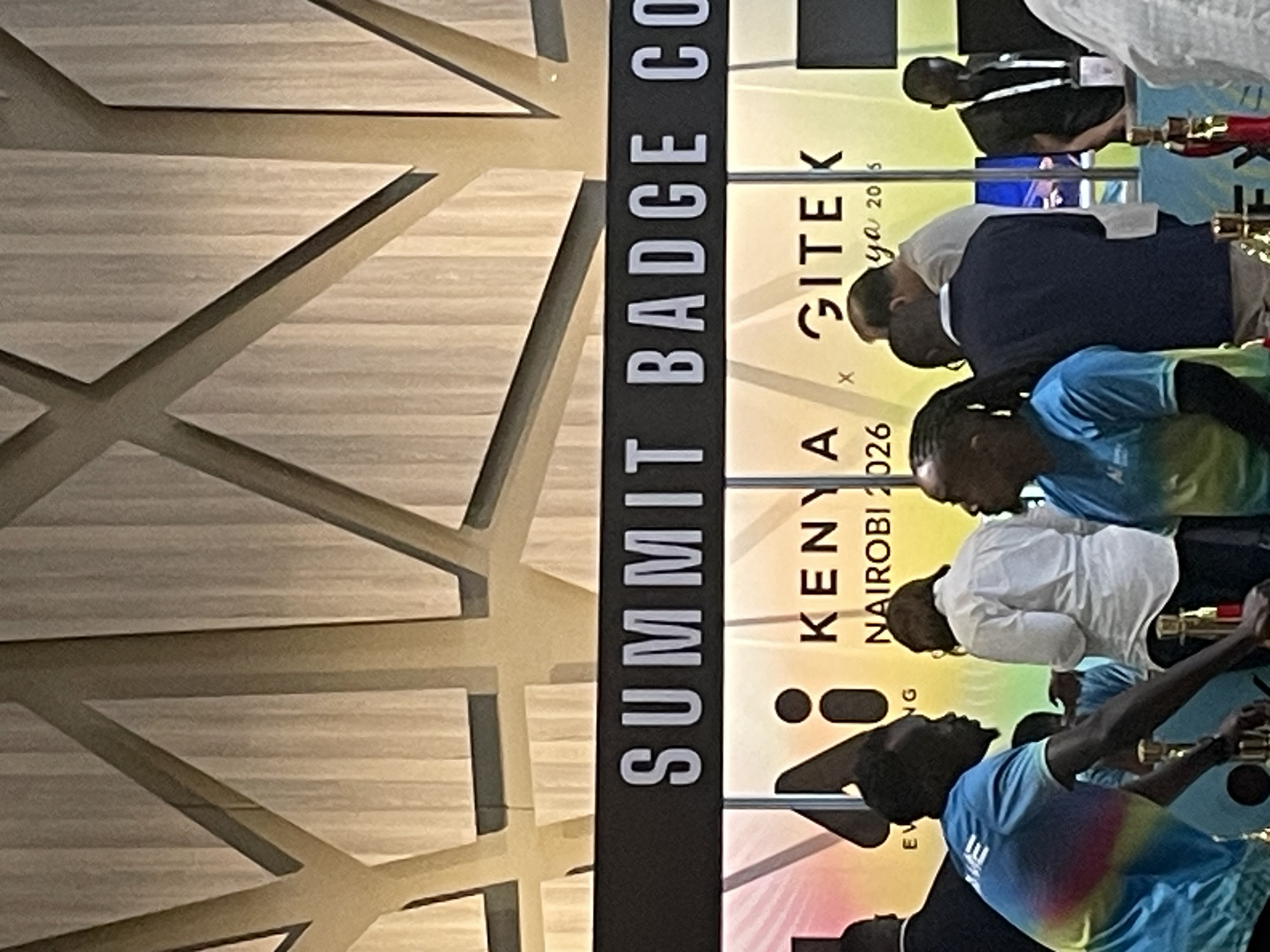
Delegates from 75 countries collected badges at KICC — nearly 60% of exhibitors were showing at a Kenyan B2B expo for the first time.
AI for schools: the opportunity Kenyan institutions cannot ignore
This is where we spent most of our attention at the event, because it's where our clients live.
Kenyan schools sit on a strange contradiction. Parents now research schools online, message on WhatsApp, and expect instant answers — but most schools still run admissions and parent communication the way they did in 2010: a phone that rings during office hours and a secretary drowning in the same fifteen questions every single day.
Here's what AI changes, concretely:
Admissions assistants that never sleep
An AI admissions assistant is a chatbot trained on your school's actual information — fee structure, curriculum, required documents, term dates, boarding arrangements. A parent visits your website or messages your WhatsApp line at 9 p.m. and asks "What documents do I need for Grade 4 admission?" — and gets an accurate, instant answer drawn from your school's approved information. Qualified enquiries get routed to your admissions office; casual questions get answered without consuming a single staff minute.
Why does this matter for enrolment? Because admissions is a speed game. The school that answers a parent's question in two minutes wins over the school that answers tomorrow afternoon. We wrote about this exact dynamic in our guide on WhatsApp for schools — AI assistants are the natural next step of that same principle.
Parent communication without the chaos
Every Kenyan school knows the pain: term dates, fee reminders, transport changes, event notices — all pushed through WhatsApp groups that descend into noise. An AI-powered communication layer answers routine parent questions from school-approved content, so staff only handle what genuinely needs a human. Faster answers for parents; fewer repetitive messages for teachers.
Personalised learning — with an honest caution
Platforms like M-Shule and Eneza Education already use AI to adapt lessons to each student's pace, and the results in underserved communities have been genuinely encouraging. Kenya's Ministry of Education is developing policy with the EU on integrating AI into the curriculum.
But we'll be honest about what we also heard at the event and in the wider conversation: educators at recent Kenya EdTech summits have warned clearly that AI is a tool, not a teacher replacement — and that unguided student use of AI can undermine the very critical-thinking skills the CBC curriculum exists to build. The schools that win with AI will be the ones that deploy it on the administrative and communication side first — where the gains are pure — while introducing it in the classroom deliberately and with teacher training.
Where a school should actually start
Not with the classroom. Start with the three highest-friction, lowest-risk areas:
- Your website — make it answer the questions parents actually ask (we covered the essentials in 7 things every Kenyan school website needs)
- An admissions assistant — on the website and WhatsApp, trained on your real fee structure and requirements
- Automated parent FAQs — term dates, uniforms, transport, documents
That sequence improves enrolment and reduces staff workload without touching a single lesson plan.
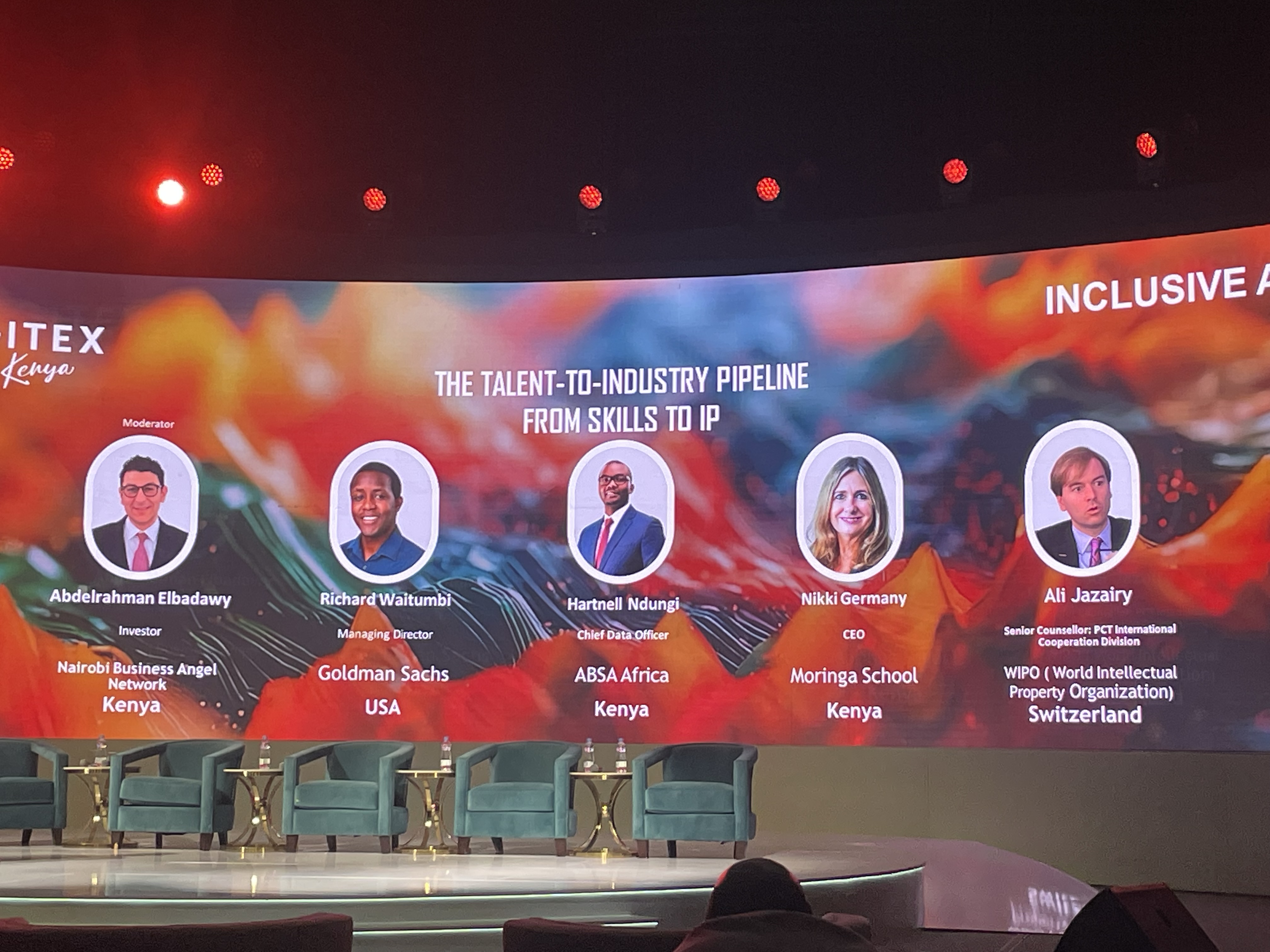
The talent-to-industry pipeline discussion — Kenya's youth are the region's biggest AI asset, but skills need somewhere to go.
AI for small businesses: what you can do this month, with real tools
Now the section for every SME owner reading this. Forget the $50 billion investment headlines for a moment. Here is what AI means for a salon in Westlands, a hardware shop in Eastleigh, a logistics firm in Industrial Area, or a printing business in town.
The core insight from GITEX — repeated by speaker after speaker — is that the cost barrier has collapsed. A single entrepreneur in Nairobi can now deploy the same class of AI tools as a funded startup in San Francisco, mostly on free tiers. The gap between AI-enabled businesses and manual ones is widening daily — and the tools are sitting there waiting.
Use case 1: Customer service on WhatsApp (the big one)
In Kenya, your business lives on WhatsApp. An AI assistant trained on your price list and FAQs can handle the endless "How much is this?", "Where are you located?", "Do you deliver?" messages — instantly, 24/7 — and hand over to you only when a real sale is closing. Tools like ManyChat (free tier available) make this accessible without any coding. Businesses using WhatsApp automation report handling several times the enquiry volume with the same staff.
Example: A boutique gets 60 WhatsApp messages a day. Forty of them are the same five questions. An AI assistant answers those forty instantly. The owner now personally handles only the twenty conversations that actually lead to sales — and no customer ever waits two hours for a price.
Use case 2: Content and marketing
Writing captions, product descriptions, flyers, and posts is a full-time job you probably don't have time for. ChatGPT and Claude (both free to start) draft your written content; Canva AI turns a single product photo into a week of social media visuals. The catch — and we say this as a design agency — is that pure AI output looks templated. Use AI for the volume; use human judgement (or a professional) for the brand.
Use case 3: M-Pesa and bookkeeping automation
This one is uniquely Kenyan and it was demonstrated on the GITEX floor: automation tools like n8n connect directly to Safaricom's Daraja API. The moment a payment hits your till, the sale is recorded, the receipt is drafted, and the customer gets an automatic confirmation. Tools like Booke.ai go further — reading receipts and invoices from your emails and categorising transactions automatically. Hours of month-end reconciliation, gone.
Use case 4: Scheduling and operations
A service business (plumbers, cleaners, technicians) can use AI scheduling that lets customers book instantly via website or WhatsApp, optimises routes, and sends automated reminders. Documented results from Kenyan SMEs include no-show reductions of around 40% from reminders alone.
The realistic budget
A practical full stack — WhatsApp automation, an AI writing assistant, design tools, and basic workflow automation — runs roughly $30–80 per month (KSh 4,000–10,500). Most of these tools have genuinely usable free tiers to start with. Compare that with the cost of one additional employee, and the maths explains why speaker after speaker at GITEX called this the great leveller.
How to start without overwhelming yourself
The most common reason AI adoption fails in small businesses is trying everything at once. The sequence that works:
- List your most repeated tasks — the messages you type again and again, the posts you struggle to create, the reconciliation you dread
- Pick ONE tool for the biggest pain — for most Kenyan businesses that's WhatsApp automation
- Run it for a month, measure the hours saved, then add the next tool
- Save your best prompts in a shared document so your whole team benefits
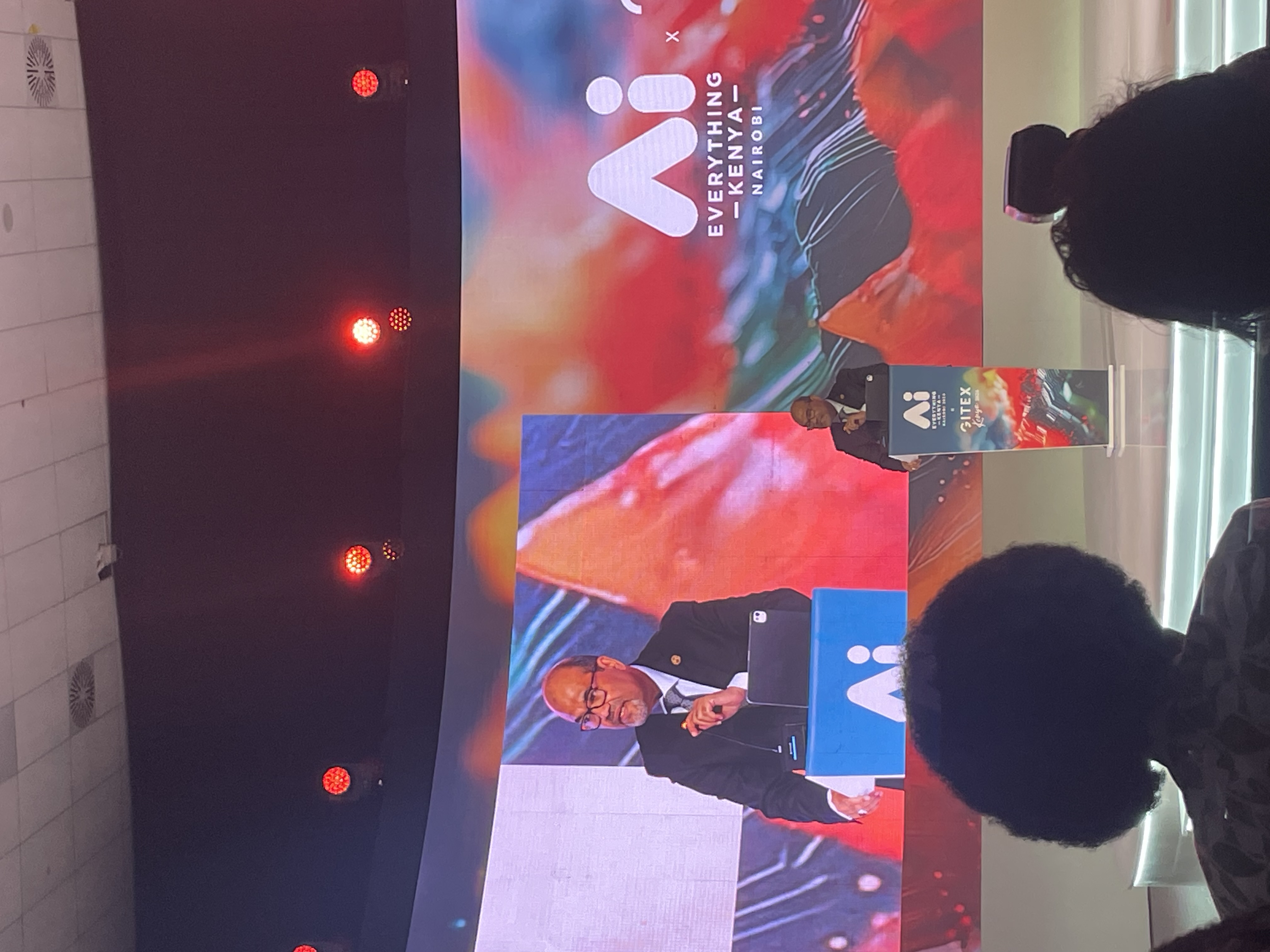
Speaker after speaker returned to one theme: AI adoption in Africa is no longer about capability — it's about who moves first.
What we're honestly cautious about
A useful article tells you the risks too. Three things came through at the event and in Kenya's policy conversation:
Data protection is not optional. Kenya's Data Protection Act applies to AI. If you collect customer information for one purpose, you cannot quietly feed it into an AI tool for another without a lawful basis. The proposed AI Bill (2026) will formalise this further with an AI Commissioner's office. Use reputable, business-grade tools — not random free apps — for anything involving customer data.
AI output needs human review. These tools are confidently wrong sometimes. Never publish AI-generated prices, dates, or claims without checking them. AI for speed, human judgement for accuracy.
Don't automate what makes you special. If customers love your business because of you — your taste, your warmth, your judgement — automate the admin around that experience, never the experience itself.
The bottom line from three days at KICC
AI Everything Kenya x GITEX Kenya 2026 was a signal, not just an event. The infrastructure is being built here. The government strategy exists. The tools cost less than a part-time employee. The question facing every Kenyan school and small business in 2026 is not whether to adopt AI — it is how quickly to begin, and how sensibly.
Start small. Pick one tool. Solve one real problem. Measure it. Then build.
Where Hatz Visuals fits in
We attended GITEX for the same reason we do everything: to serve our clients better. Hatz Visuals Limited is a Nairobi creative agency focused on admissions growth for Kenyan schools and digital growth for institutions — we build websites that convert enquiries, run social media that reaches parents where they are, execute digital marketing that fills open days, and produce the print materials that close the decision.
Everything we saw at GITEX confirmed the direction we've been building toward: the schools and businesses that pair a strong digital foundation with smart, honest use of AI will pull decisively ahead in the next three years. If you're a school director wondering what an admissions assistant could do for your enrolment, or a business owner who wants a website and marketing system built AI-ready from day one — talk to us. The first conversation is free, and we'll tell you honestly what's worth doing and what isn't.
Hatz Visuals Limited — Kenya's admissions-growth partner. Nairobi, Kenya.
Written by
Admin
Published 13 July 2026
Did you find this useful?
Explore Hatz Visuals
Comments
Leave a comment